A language that standard Dutch speakers cannot understand
If you think everyone in the Netherlands speaks the exact same flat version of Dutch, a trip south will quickly prove you wrong. The province of Limburg has a linguistic identity so fierce that the government recognized Limburgs as an official regional language in 1997.
It is not just a funny accent or a collection of rural slang terms. An untrained listener from Amsterdam will sit in a local pub and barely understand a single word. Limburgs uses rather different grammar, vocabulary and pronunciation rules that set it far apart from standard Dutch.
The musical language where pitch changes everything
The most fascinating technical aspect of Limburgs is that it uses a pitch accent system. It is one of the extremely rare tonal languages in Europe. Pitching a vowel sound higher or lower changes the actual meaning of a word.
A dragging tone can mean a single mountain, while an abrupt short tone turns it into the plural form. Standard Dutch relies on adding extra letters to the end of words for plurals, but Limburgs just changes the musical note. This gives the language its famous sing-song quality that sounds almost like melodic chanting.
German roots and three grammatical genders
Limburgs sits right along the border with Germany, which heavily shaped its historic development. While standard Dutch evolved through sound shifts, Limburgs kept older Germanic sounds. Words like “ik” and “maken” in Dutch become “iech” and “maoke” in Limburgs.
Grammar lovers will also notice three distinct grammatical genders still alive and kicking. Standard Dutch mostly collapsed everything down into a basic binary system. Limburgs stubbornly keeps masculine, feminine and neuter forms, forcing adjectives to change depending on what you are talking about.
The peculiar urban micro language of Maastricht
Calling Limburgs a single language is actually a bit misleading. Virtually every village in the province speaks its own distinct variation. However, the city dialect of Maastricht, known as Stadsmaastrichts or Mestreechs, takes regional pride to a whole new level.
Spoken natively by around sixty thousand residents, Mestreechs carries a massive amount of historic French influence. Maastricht was historically co-ruled by Belgian powers and taught French in local schools. As a result, the city dialect is packed with French words.
French throat sounds and beer bottle labels
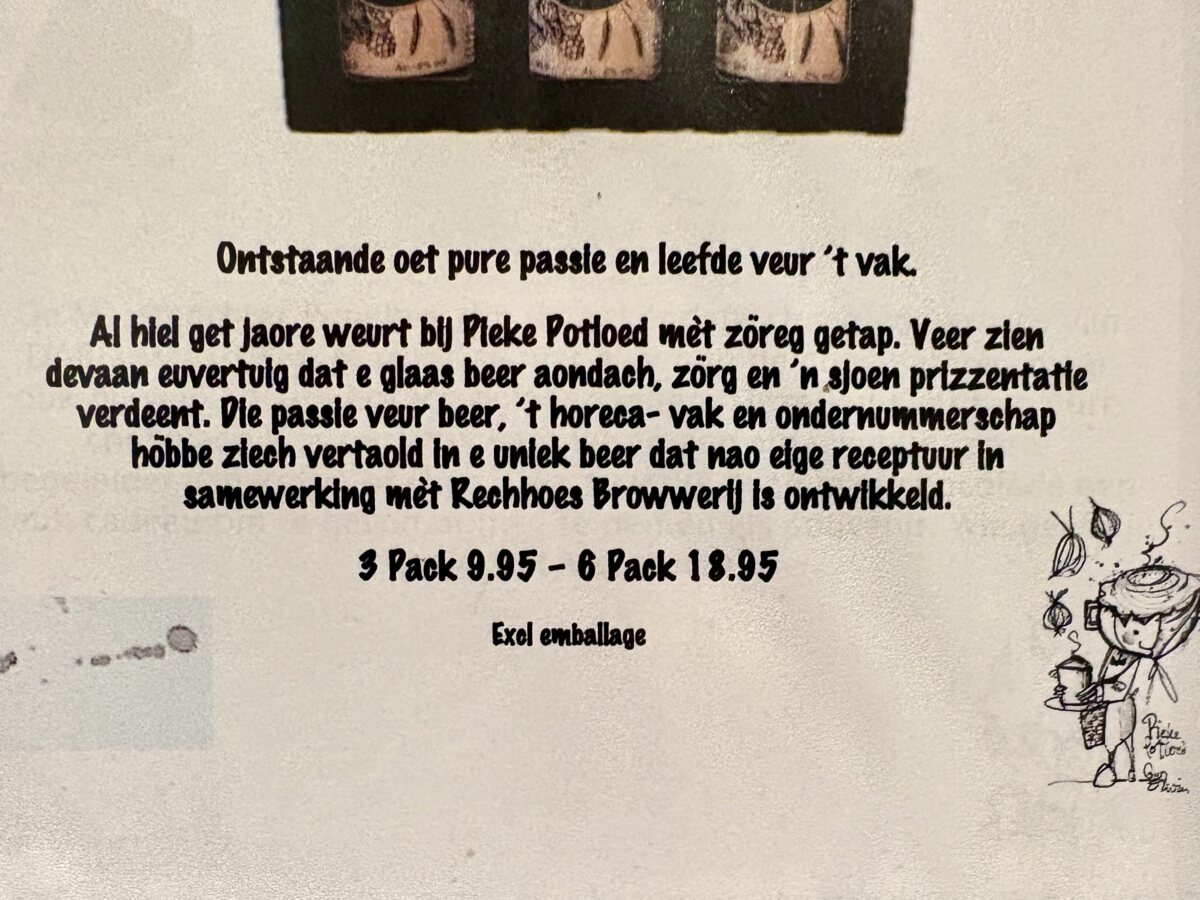
Locals in Maastricht pronounce their R sounds in the back of the throat, exactly like native speakers in Paris. This French flair makes Mestreechs sound remarkably elegant compared to the harder dialects spoken in the rural countryside. Local residents guard their city tongue fiercely as a badge of urban prestige. You can spot this unique dialect printed directly for example on local beer bottles