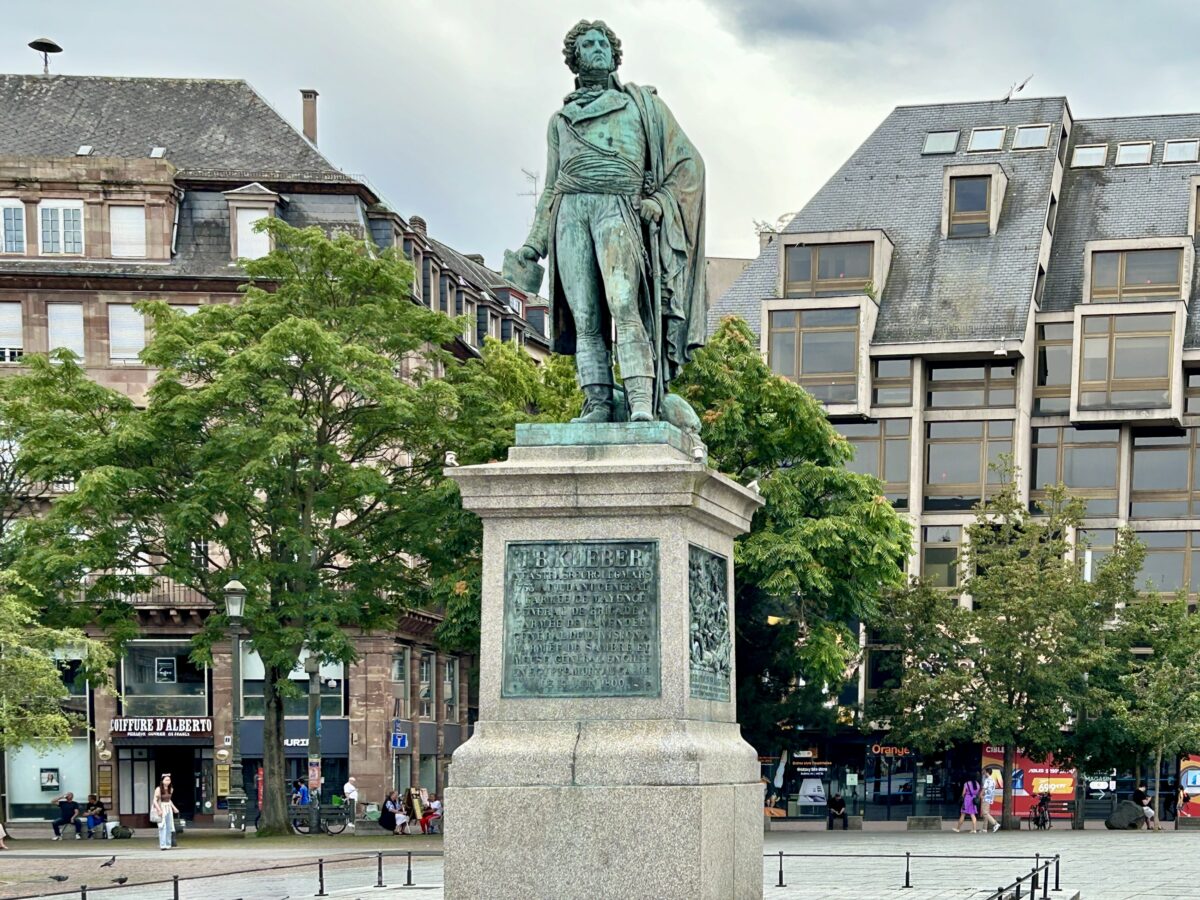
Place Kléber is the beating heart of Strasbourg, the kind of place where locals meet, tourists snap selfies, and pigeons hold their daily summits. But beneath all that bustle lies a story that’s anything but ordinary.
Named after General Jean-Baptiste Kléber, this square has seen centuries of drama, transformation and the occasional oversized Christmas tree. It’s the largest square in Strasbourg and sits in the middle of the city’s historic centre. It’s also where Kléber himself is buried — right under his statue.
A brief history of the square
Originally called Barfüsserplatz (which sounds like a foot condition but actually means “barefoot square” in German), the area was once home to a Franciscan monastery. Later, it became a military parade ground known as Place d’Armes. In 1840, it was renamed Place Kléber when the general’s remains were finally laid to rest there.
The square has been through a lot. During the German occupation in World War II, it was renamed after Karl Roos, a local politician. After the war, it reclaimed its original name and its dignity. Today, it’s a pedestrian zone filled with shops, cafés and the occasional protest. It’s also the site of Strasbourg’s famous Christmas market, where a fir tree is erected every year.
Who was Jean-Baptiste Kléber?
Born in Strasbourg on 9 March 1753, Kléber was the son of a mason and started out as an architect. He designed buildings, drew up plans and probably had strong opinions about roof angles. But when the French Revolution kicked off, he swapped his compass for a sabre and joined the army.
Kléber quickly rose through the ranks thanks to his military talent and a knack for not dying in battle. He fought in the Vendée, defended Mainz, and played a key role in the Battle of Fleurus. Napoleon liked him enough to drag him along to Egypt, where Kléber ended up in charge after Napoleon scarpered back to France. Kléber tried to negotiate peace, then crushed the Turks at the Battle of Heliopolis. Sadly, his career was cut short when he was assassinated in Cairo on 14 June 1800 by a theology student with a dagger and questionable life choices.
His body was shipped back to France, but Napoleon, ever the drama queen, didn’t want Kléber’s tomb to become a Republican shrine. So the poor man’s remains sat in storage at the Château d’If for 18 years. Eventually, Louis XVIII allowed him to be buried in Strasbourg, under the statue that now dominates the square.
The statue and the legacy
The statue of Kléber was designed by Philippe Grass and completed in 1838. It’s not just decorative, it’s also a tomb. Beneath it lies the general himself, making Place Kléber one of the few public squares where you can sip coffee next to a buried war hero.
Kléber’s legacy is a mix of military brilliance, architectural flair and a stubborn refusal to play politics. He was known for being brave, blunt and not particularly fond of authority. In short, he was the kind of person who’d roll his eyes at motivational posters and get things done anyway.
Why visit Place Kléber?
If you’re in Strasbourg, you’ll end up here whether you mean to or not. It’s central, lively and surrounded by everything from historic buildings to trendy shops. The Aubette building on the north side is worth a look — it’s been restored and now houses modern art installations. And if you’re lucky enough to visit in December, the Christmas market will make you feel like you’ve stepped into a festive fairy tale.