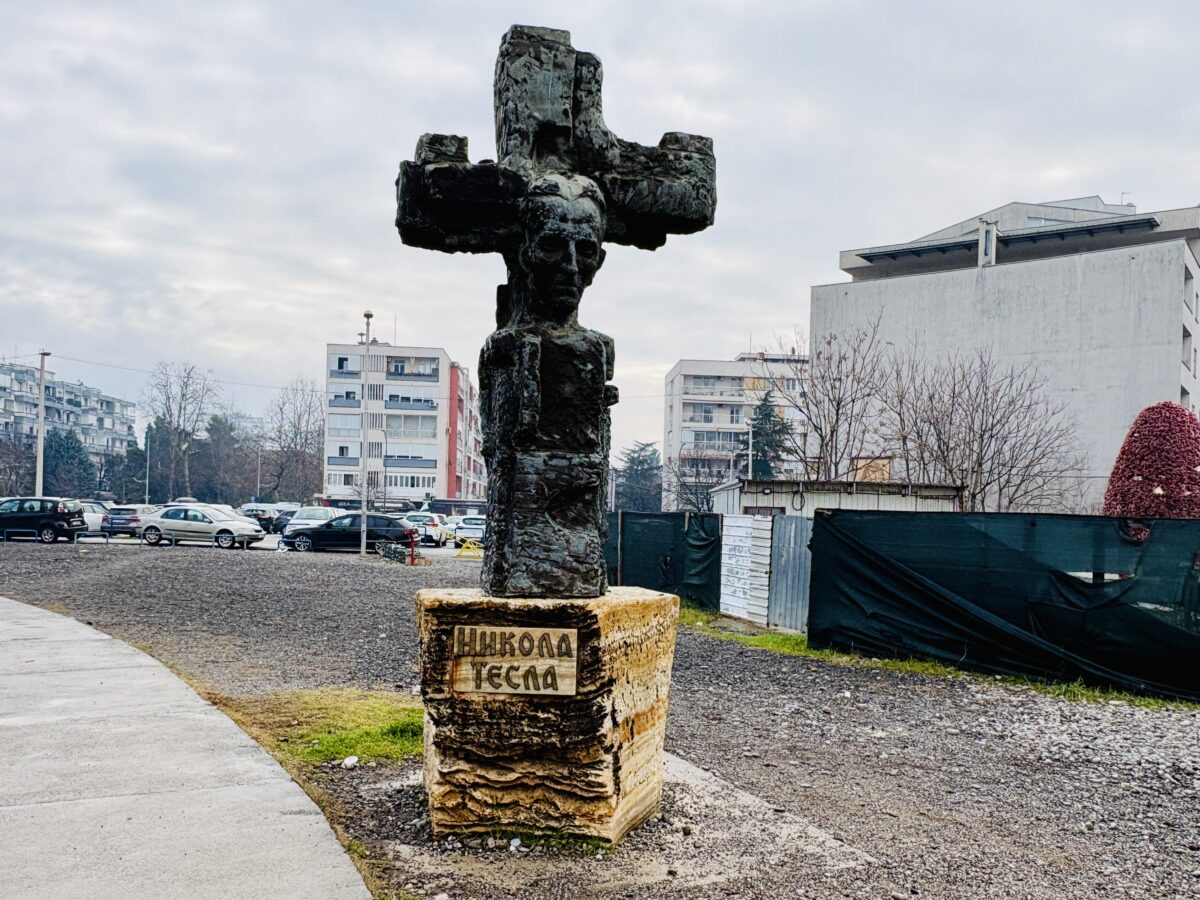
A strange statue stands next to the cathedral in Podgorica. It shows Nikola Tesla in a thoughtful pose with a large cross rising behind him. It looks like he is either receiving divine inspiration or waiting for someone to explain why a scientist famous for electricity is suddenly part of a religious tableau. It is one of the most curious monuments in Montenegro and it has a story that is just as unusual.
A statue with a surprising backdrop
The statue of Nikola Tesla in Podgorica is not hidden in a quiet park. It stands proudly next to the Cathedral of the Resurrection of Christ. The cathedral is huge and dramatic. The statue is calm and elegant or surprising to the least. The cross behind Tesla is even taller than he is. The whole scene looks like a collaboration between a sculptor and someone who misread the assignment.
The cross is not there by accident. It symbolises the idea that Tesla’s genius was a gift. It also reflects the belief held by some in the region that Tesla’s scientific work and his spiritual background are connected. Whether Tesla would have agreed is another question. He was known for many things but not for posing next to giant crosses.
Why the statue is in Podgorica
Tesla never lived in Podgorica. He never worked there. He never invented anything there. But Montenegro likes to claim him as one of its own. So does Croatia. So does Serbia. In fact half the Balkans proudly declare that Tesla belongs to them. It is a regional sport.
Tesla was born on 10 July 1856 in Smiljan. At the time it was part of the Austrian Empire. Today it is in Croatia. His family was Serbian Orthodox. His father was a priest. His mother was known for her creativity and her inventions at home. This mix of cultures and identities is why several countries feel connected to him. It is also why statues of Tesla appear in places he never visited. Podgorica included.
A short biography of a long legacy
Tesla was one of the greatest inventors of the modern age. He worked on alternating current. He developed early radio technology. He experimented with wireless energy. He dreamed of global communication long before the internet existed. He also had a talent for dramatic ideas that made investors nervous.
He moved from Europe to the United States where he worked with and later against Thomas Edison. Their rivalry is famous. Edison preferred direct current. Tesla preferred alternating current. The world eventually chose Tesla’s system. Edison probably did not send him a thank you card.
Tesla died in 1943 in New York. He left behind hundreds of patents and a reputation that only grew after his death. Today he is celebrated as a visionary. He is also celebrated as a national hero by several countries at the same time. This is impressive. Even football players rarely achieve that.
On 10 July 2026 the world marks the 170th anniversary of Tesla’s birth. Podgorica’s statue is a reminder of how far his influence reaches. Even cities he never visited honour him. Even monuments he never imagined carry his name.
And if you stand in front of the statue long enough you may feel inspired. Or at least amused. Which is already a fine tribute to a man who lit up the world.