A language that refuses to disappear
The Basque language, also known as Euskara, is one of Europe’s linguistic rebels. It has no known relatives and refuses to be bullied into extinction. In the French Basque Country, or Iparralde, it’s been quietly making a comeback. Not thanks to Paris, mind you, but mostly because locals just won’t let it go.
Despite France’s love affair with centralisation and its one-language-fits-all approach, Basque is taught in schools. Not everywhere, and not always well, but still. Around 20 percent of people in Iparralde speak Basque. That’s roughly 50,000 speakers. And about one third of pupils in the region now receive some form of Basque education. That’s 48 percent in pre-school, 40 percent in primary, and 23 percent in secondary. Not bad for a language that was once considered a threat to national unity.
Primary school: where the magic happens
Primary education is where Basque really gets a chance to shine. Immersive and bilingual programmes are growing. Some pupils speak Basque at home, others don’t. But the idea is to get everyone comfortable in both French and Basque. It’s not mandatory, it depends on how many parents ask for it. Democracy in action, with a touch of paperwork. The results are promising. Studies show that pupils in bilingual programmes develop strong skills in both languages.
France vs Spain: A tale of two policies
Cross the border into Spain and you’ll find a very different story. In the Spanish Basque Country, Basque is an official language. It’s used in schools, government, and even on road signs. Spain, despite its own centralising instincts, has allowed regional languages to flourish. Basque, Catalan, Galician, they all get a seat at the table.
In France, Basque is still unofficial. It’s tolerated, occasionally encouraged, but never fully embraced. The French Republic likes its citizens to speak French. Preferably with no accent and lots of grammar.
The École communale des filles: not just for girls
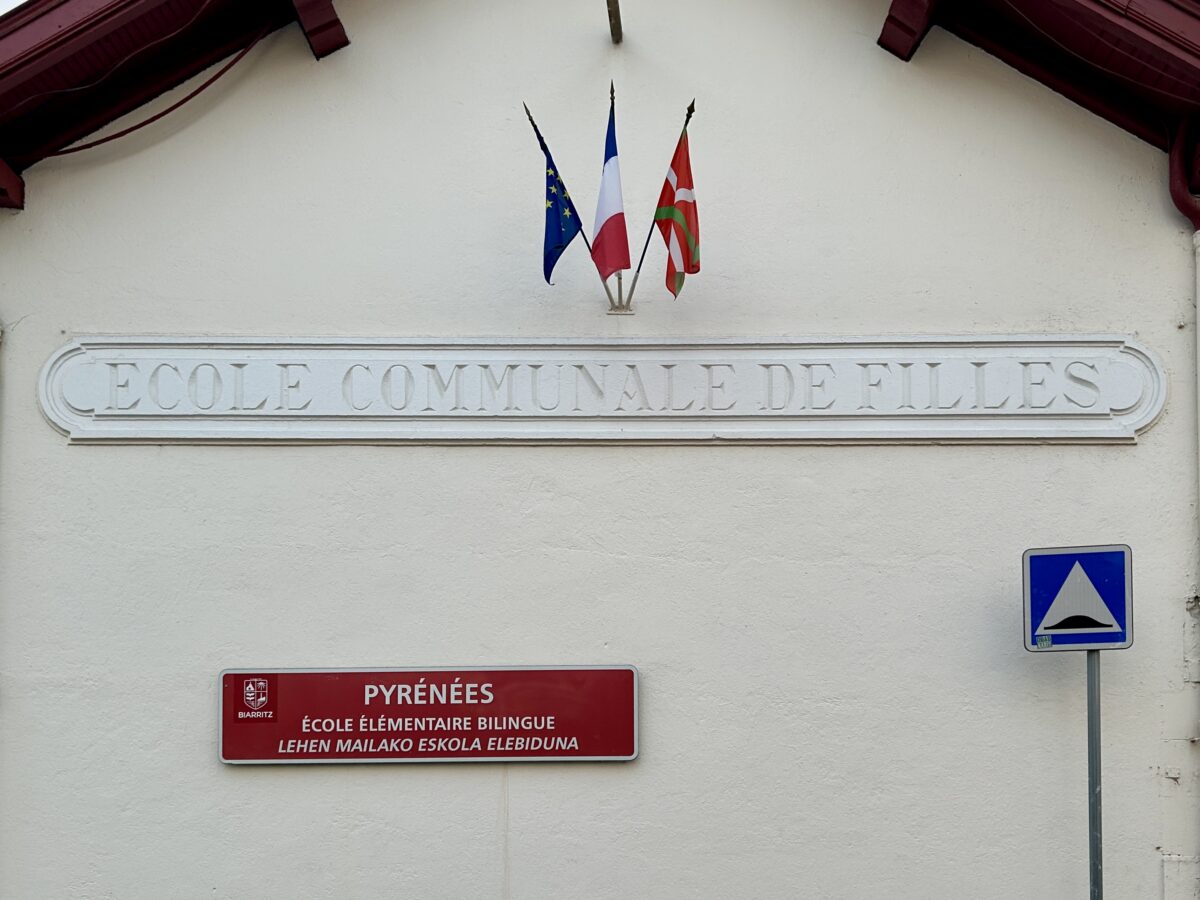
Now let’s talk about the charmingly named École communale des filles in Biarritz. It sounds like a school for young ladies in frilly dresses. In reality, it’s a regular public school. The name is a leftover from a time when schools were strictly divided by gender. Today, boys and girls attend together, and no one wears lace unless it’s carnival.
What makes this school interesting is its bilingual programme. It offers Basque-French education, giving pupils a chance to learn both languages from an early age. It’s part of a wider movement in Biarritz and the region to revive Basque through education. And it’s working. Slowly, but surely.
A revival worth watching
The revival of Basque in France is a bit of a miracle. It’s happening despite decades of neglect, centralised policies, and a general lack of enthusiasm from Paris. Local efforts, community support, and a stubborn love for the language are keeping it alive.
It’s not perfect. There’s a shortage of Basque-speaking teachers. Funding is patchy. And the political will is lukewarm at best. But the numbers are growing, and the language is being passed on. In classrooms, playgrounds, and even in schools with misleading names.
A story of a quiet resistance
Basque in France is a story of quiet resistance. It’s not loud or flashy. It doesn’t get much airtime in national debates. But it’s there in the voices of children learning to count in two languages and in the increasing number of signs outside schools. And it is also there in the determination of parents who want their kids to speak the language of their grandparents.
It’s a small victory for linguistic diversity. And a reminder that even in France, not everything has to be in French.