Lenin with attitude on a burger wall
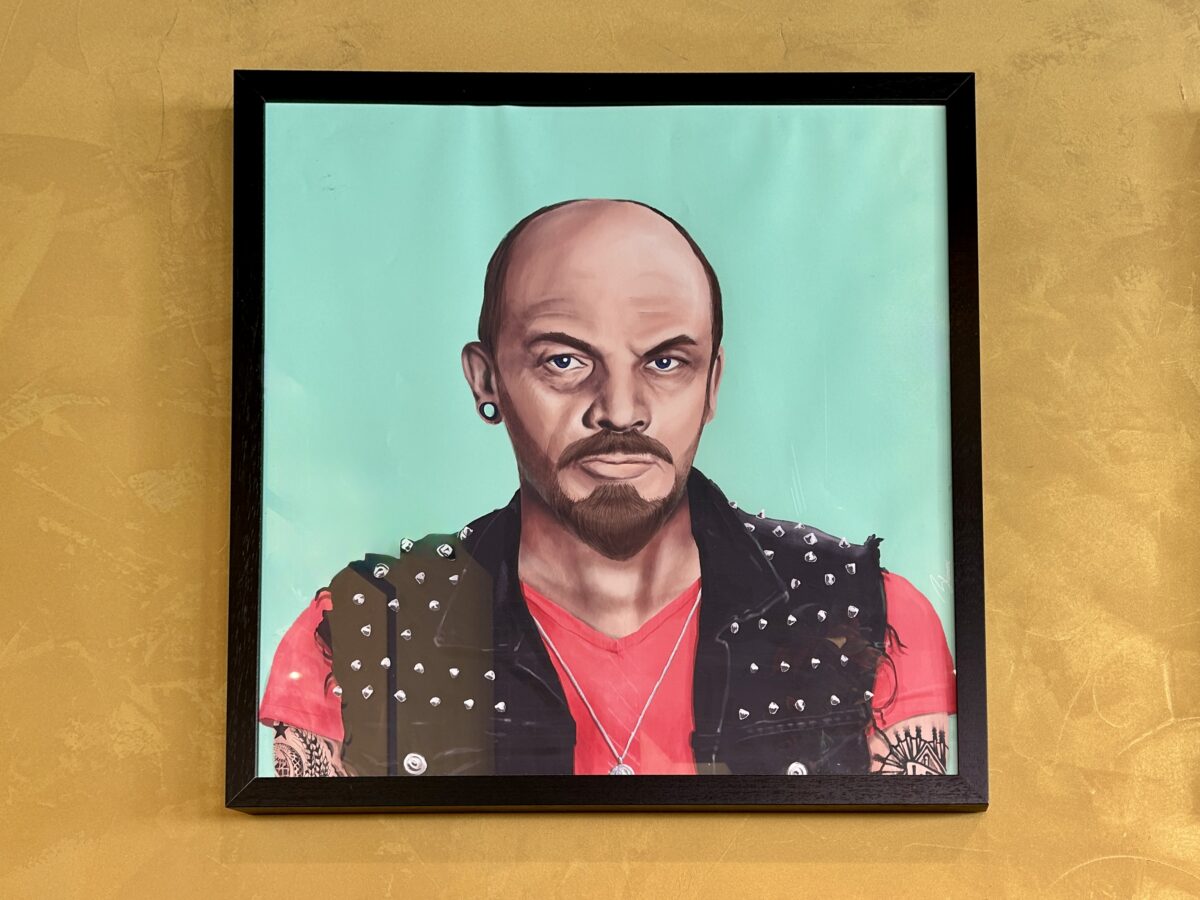
Walk into Burger House Trier and you will quickly realise that the walls have a sense of humour. Among the portraits of world leaders who never imagined they would end up decorating a restaurant in such outfit, you will find Lenin. Not the stern revolutionary from the history books. Not the man giving speeches in Petrograd. No. Here he appears as a rock star, complete with a spiked leather jacket and earrings that would make any punk band proud.
It is part of the restaurant’s playful tradition. They take historical figures and give them a makeover that no biography ever dared to include. Other leaders look ready to headline a festival rather than lead a nation. It is absurd, clever and surprisingly effective at making people smile while waiting for their burgers.
A birthday worth noting
Lenin was born on 22 April 1870. That makes this year his 156th anniversary. A good moment to remember who he really was, beyond the leather jacket and the artistic reinterpretation.
His real name was Vladimir Ilyich Ulyanov. He became the leader of the Bolsheviks, the organiser of the October Revolution and the founder of the Soviet state. He spent years in exile, wrote endlessly and believed he was building a better world. It is less and less debated today that he has not succeeded.
A life of ideas and consequences
Lenin was brilliant, disciplined and absolutely convinced of his mission. He pushed for a political system that promised equality but introduced censorship, repression and a one party structure. He justified these measures as necessary for revolution. Critics have pointed out that necessity can be a very convenient word.
He died in 1924 after several strokes. By then the foundations of the Soviet Union were firmly in place. What followed under Stalin was far more brutal, but many of the early mechanisms were already visible during Lenin’s rule. His legacy is therefore complex. Some admire him as a revolutionary thinker. Others see him as the man who opened the door to decades of authoritarianism.
Why he appears in a burger restaurant
This is where Burger House Trier’s humour shines. They are not rewriting history. They are simply playing with the contrast between serious figures and light hearted pop culture. Lenin in a spiked leather jacket is funny precisely because it is so far from reality. It reminds us that even the most intimidating historical characters can be turned into quirky illustrations when placed next to a plate of fries.
The portraits are part of the restaurant’s identity. They create a relaxed atmosphere and show that history can be approached with a bit of irony. Not everything needs to be solemn. Especially not when you are eating a cheeseburger.
A gallery of unexpected celebrities
Lenin is not alone on the wall. De Gaulle appears with a surprising amount of attitude. Other leaders and cultural icons receive similar treatment. The result is a gallery that feels like an alternative universe where world history was written by a group of musicians who never learned to tune their guitars.
It is harmless fun. It makes you look twice. And it proves that even the most serious historical figures can become pop culture material with the right artistic twist.
A birthday with a smile
So on this 22 April, 156 years after Lenin’s birth, it feels appropriate to acknowledge both sides of his legacy. The real one, which shaped the twentieth century in ways both inspiring and troubling. And the humorous one, which now hangs on a wall in Trier wearing a leather jacket he never owned.
History is complicated. Burgers are simple. And sometimes it is nice to enjoy both at the same time.