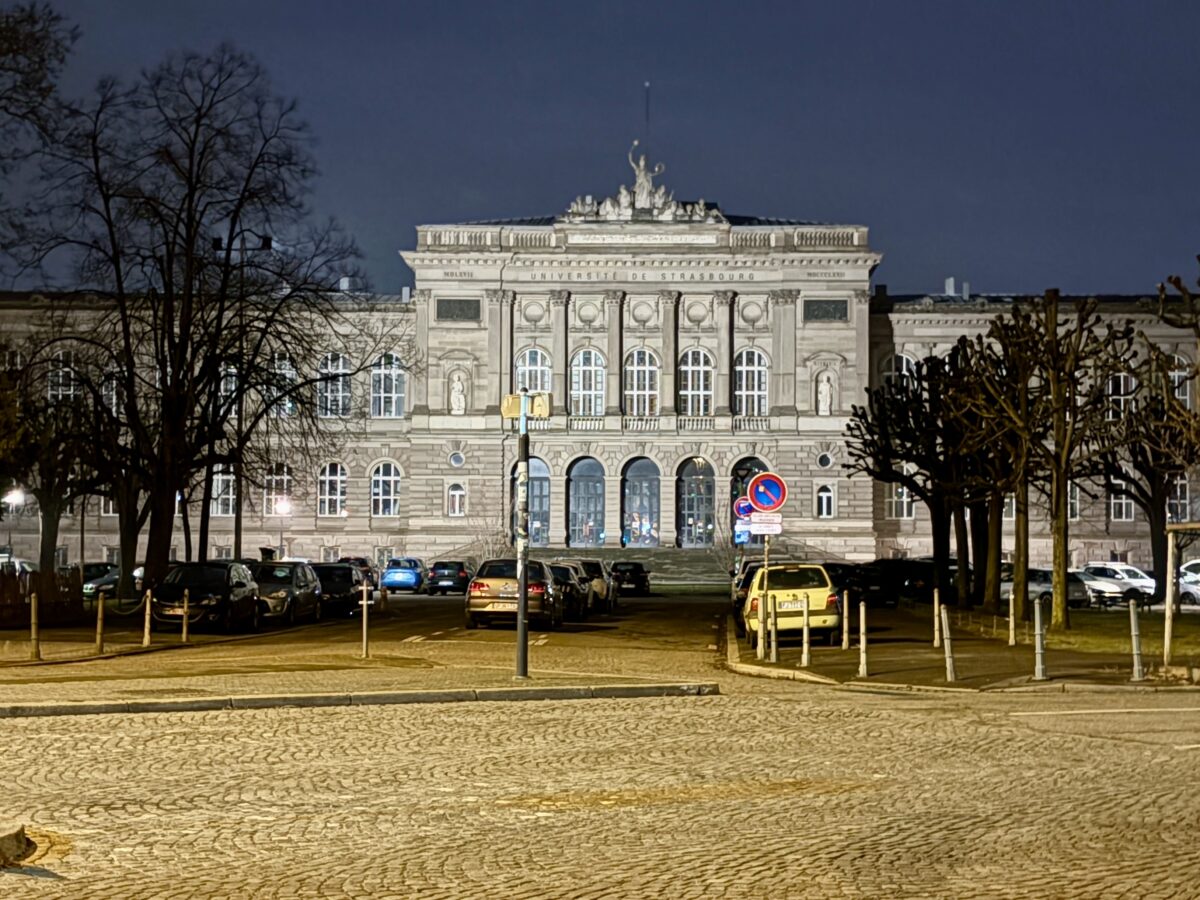
The palace that wanted to impress everyone
The Palais universitaire of Strasbourg is one of those buildings that you will remember once you saw it. It was built in the late nineteenth century when Strasbourg was part of the German Empire. The authorities wanted a university that would show the world how cultured and sophisticated they were. The result was a palace that looks like it could host emperors but also philosophers and linguists.
The building stands proudly along the Ill river. (It is I and double L and not the number three in roman, just to be on the safe side.) Its long façade, elegant columns and sculpted figures give it a sense of authority. It is the kind of place where you instinctively lower your voice even if no one asked you to.
A bit of history with shifting borders
The Palais universitaire was completed in 1884. At that time Strasbourg was under German rule. The new university was meant to be a symbol of intellectual power. The architects chose a style inspired by the Italian Renaissance which was fashionable and suitably grand.
After the First World War the city returned to France. The university changed hands again and adapted to its new national context. The building stayed the same but the languages spoken inside it changed more than once. It has seen German professors, French professors and generations of students who probably spent more time in cafés than in lecture halls.
Architecture that loves to show off
The architecture of the Palais universitaire is a celebration of symmetry and classical beauty. The central entrance is framed by tall Corinthian columns. The interior has wide staircases, long corridors and high ceilings that make you feel very small and very studious.
The main hall is decorated with statues of famous scholars. They look down at visitors with the expression of people who have read far more books than you ever will. The building is full of details that remind you that education was once considered a noble and slightly intimidating affair.
What happens inside today
Despite its palatial appearance the building is not a museum. It houses part of the administration of the University of Strasbourg. Offices, meeting rooms and academic services occupy much of the space. Students come here for registrations, certificates and the occasional bureaucratic adventure. The latter ones may be as challenging as constructing the entire building.
The palace also hosts events, conferences and public lectures. It remains a central point of the university even if most teaching now happens in other buildings scattered across the city.
The wider organisation of the University of Strasbourg
The University of Strasbourg, often called UNISTRA, is one of the largest universities in France. It brings together several faculties and institutes that were once separate. The university covers a wide range of fields from sciences to humanities and from medicine to law.
It has more than fifty thousand students and thousands of staff members. Some of its researchers are internationally recognised. The university has produced Nobel Prize winners which is always a good way to impress visitors and attract even more students.
UNISTRA is organised into faculties, schools and research units. The Palais universitaire is only one piece of this large academic puzzle. It is the ceremonial heart rather than the everyday classroom.
How it compares with other French universities
Compared with many French universities the University of Strasbourg has a unique charm. Paris has grand institutions but they are spread across the city. Lyon and Toulouse have strong academic reputations but their buildings are often more modern and less theatrical.
Strasbourg stands out because it combines German architectural ambition with French academic tradition. The Palais universitaire is a reminder of this mixed heritage. It is more monumental than most university buildings in France and certainly more decorative than the concrete campuses built in the 1960s.
A palace that still feels alive
The Palais universitaire is a place where history and daily life meet. Students walk through its corridors with laptops and headphones while the statues watch silently. Administrators work behind heavy wooden doors. Visitors admire the architecture and wonder how many stories the walls could tell.
It is a building that has survived wars, political changes and countless exam seasons. It remains one of the most beautiful university buildings in France and a proud symbol of Strasbourg’s academic life.