The birth of a metro legend
Back in the 1890s, Budapest was getting a bit too crowded. Trams, carriages, and horse-drawn omnibuses were clogging the streets like rush hour with hooves. The city needed a solution that didn’t involve more animals or shouting. Enter the Kisföldalatti, also known as Metro Line 1.
Construction began in 1894 and took just twenty-one months. That’s faster than most kitchen renovations today. Instead of tunnelling like moles, engineers simply dug up the elegant Andrássy Avenue, built the line, and then politely put the street back. It was a neat trick and avoided disturbing the city’s fancy façade.
A royal ribbon-cutting
The line opened in 1896, just in time for Hungary’s millennium celebrations. Emperor Franz Joseph himself showed up to inaugurate it. That’s how you know it was a big deal. It was the first underground railway on the European continent and only the second in the world after London’s.
Originally, the trains were electric, but before that, horse-drawn carriages were used in the city’s surface transport. Thankfully, the metro skipped the whole “horses underground” idea. Imagine the smell. Instead, it went straight to electric, which was considered futuristic at the time. People probably thought they were boarding a spaceship.
Small trains, big charm
The Kisföldalatti was built with a very low tunnel. So low, in fact, that the drivers had to crouch in their cabins like they were hiding from their boss. The trains were compact, and the stations were close together. It was more like an underground tram than a full-blown metro. But it worked, and it worked well. And it still works.
The line originally ran from Gizella tér (now Vörösmarty tér) to the City Park. It had eleven stations, and trains ran every two minutes. That’s more punctual than most modern services. The line was extended in 1973, but the original charm was carefully preserved.
Architecture with attitude
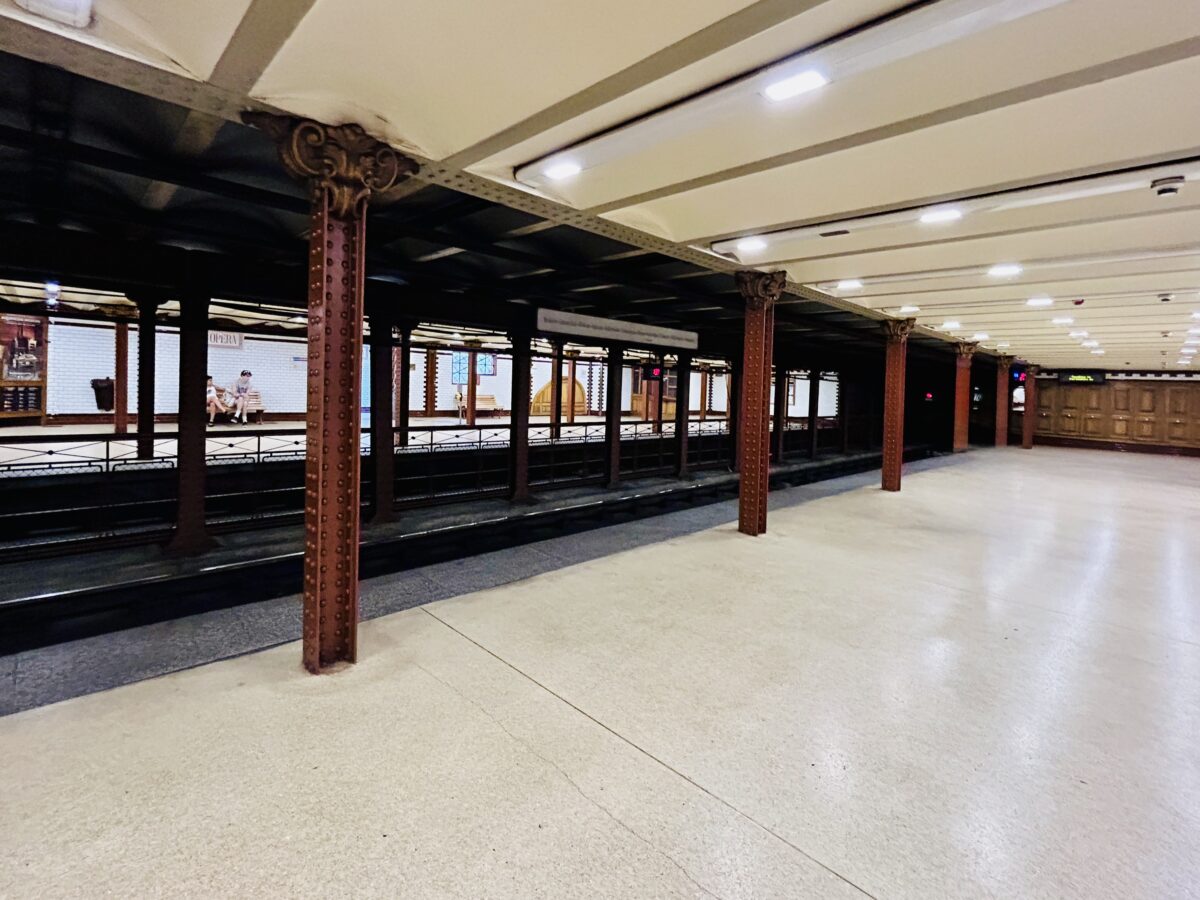
Now let’s talk about the stations. These weren’t just holes in the ground with a bench and a bin. The stations were decorated with Zsolnay tiles, ornate ironwork, and elegant signage. The Opera station, for example, looks like it was designed by someone who thought, “Yes, it’s underground, but let’s make it fabulous.”
Each station has its own personality. Some look like miniature museums. Others feel like you’ve stepped into a Wes Anderson film. It’s hard not to be impressed, unless you’re the kind of person who thinks concrete is exciting.
A heritage worth keeping
In 2002, the Kisföldalatti and Andrássy Avenue were declared UNESCO World Heritage sites. That means they’re officially too precious to mess with. The metro still runs today, and it’s beloved by locals and tourists. It’s short, sweet, and still oddly glamorous.