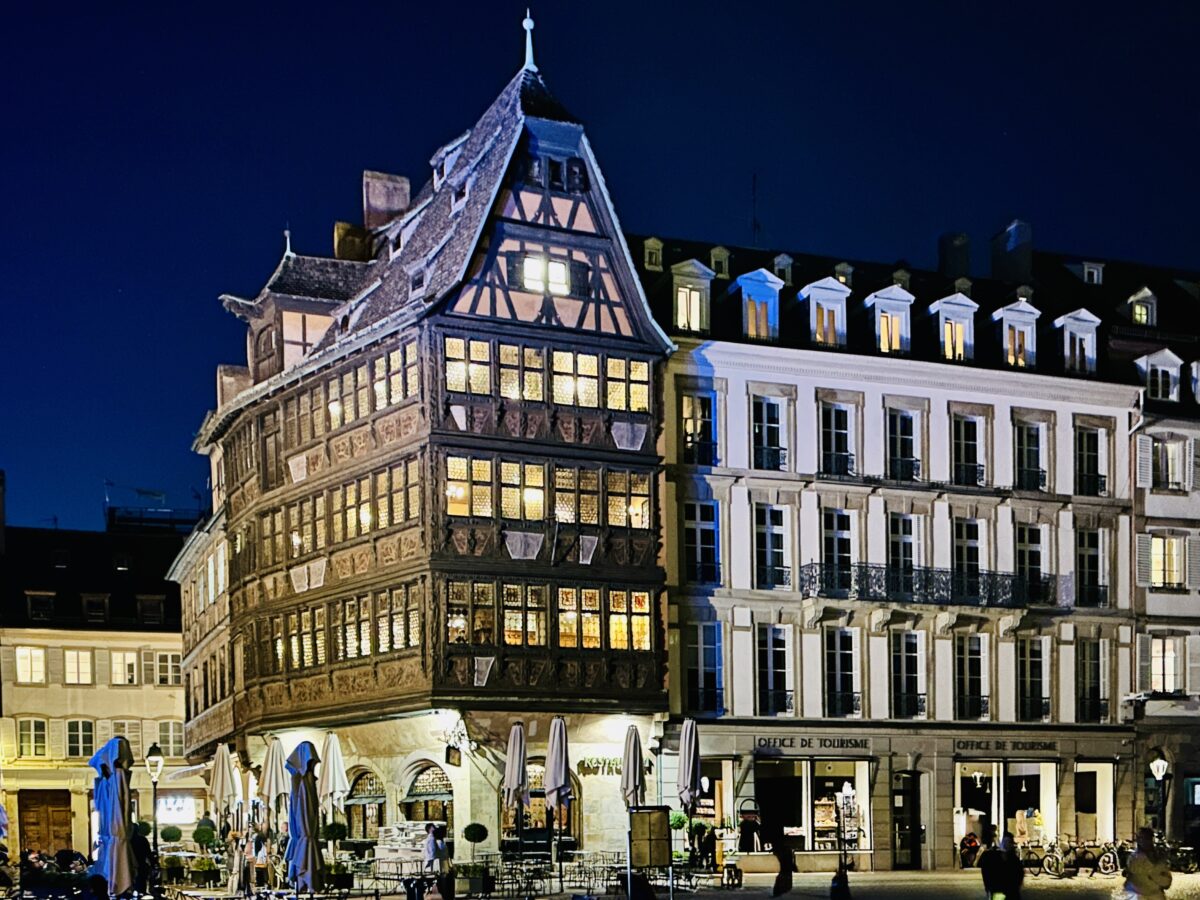
The Maison Kammerzell, known locally as s’Kammerzellhüs, is one of Strasbourg’s most iconic architectural gems. Standing proudly at No. 16 Place de la Cathédrale, this beautifully preserved building represents the pinnacle of Alsatian timber-framed design and centuries of history woven into its elaborate façade.
A Story That Spans Centuries
The origins of Kammerzell House date back to 1427, but it was in 1589 that the building took its final form. Originally owned by Hans Jœger, a draper, it passed through the hands of various merchants, including cheese trader Martin Braun, who expanded the structure with its distinctive wooden upper floors.
This Renaissance-style addition transformed the building, incorporating sculpted wooden panels adorned with sacred and secular imagery. Legends, medieval myths, depictions of the five senses and the four ages of life, as well as allegorical figures representing faith, hope, and charity, all decorate the façade. Even historical figures such as Julius Caesar and Charlemagne can be spotted among its carvings.
After years in private ownership, the building was finally acquired in 1879 by the city of Strasbourg through the foundation of l’Œuvre Notre-Dame, marking its transition into a protected historic site.
The Art and Architecture That Make It Unique
Few buildings in Strasbourg rival Kammerzell House in both artistic detail and historical importance. Its timber framework, richly sculpted with intricate carvings, makes it one of the most spectacular examples of 16th-century Alsatian architecture.
One of its most striking features is the row of windows with glass panes, which add a unique visual texture to the exterior. On the upper levels, a pulley system, once used to hoist supplies to the attic, remains as a reminder of the building’s practical past.
Over the years, restoration efforts have helped preserve its grandeur. A notable renovation in 1892 introduced polychrome paintings inspired by Rhineland art of the 16th century, adding another layer of historical richness to the building’s aesthetic.
A Culinary and Cultural Landmark
Beyond its architectural beauty, Kammerzell House has long been associated with Strasbourg’s culinary traditions. Today, the building houses a celebrated restaurant where guests can dine while surrounded by history. Inside, a striking mural by Alsatian artist Léo Schnugg, painted in 1910, illustrates an amusing culinary anecdote from 1576, further connecting the space to the city’s gastronomic past.
While the building has seen moments of darkness, including its association with political extremism in the late 1930s, it remains today one of Strasbourg’s most treasured landmarks, standing alongside the cathedral as the city’s oldest continuously used building.