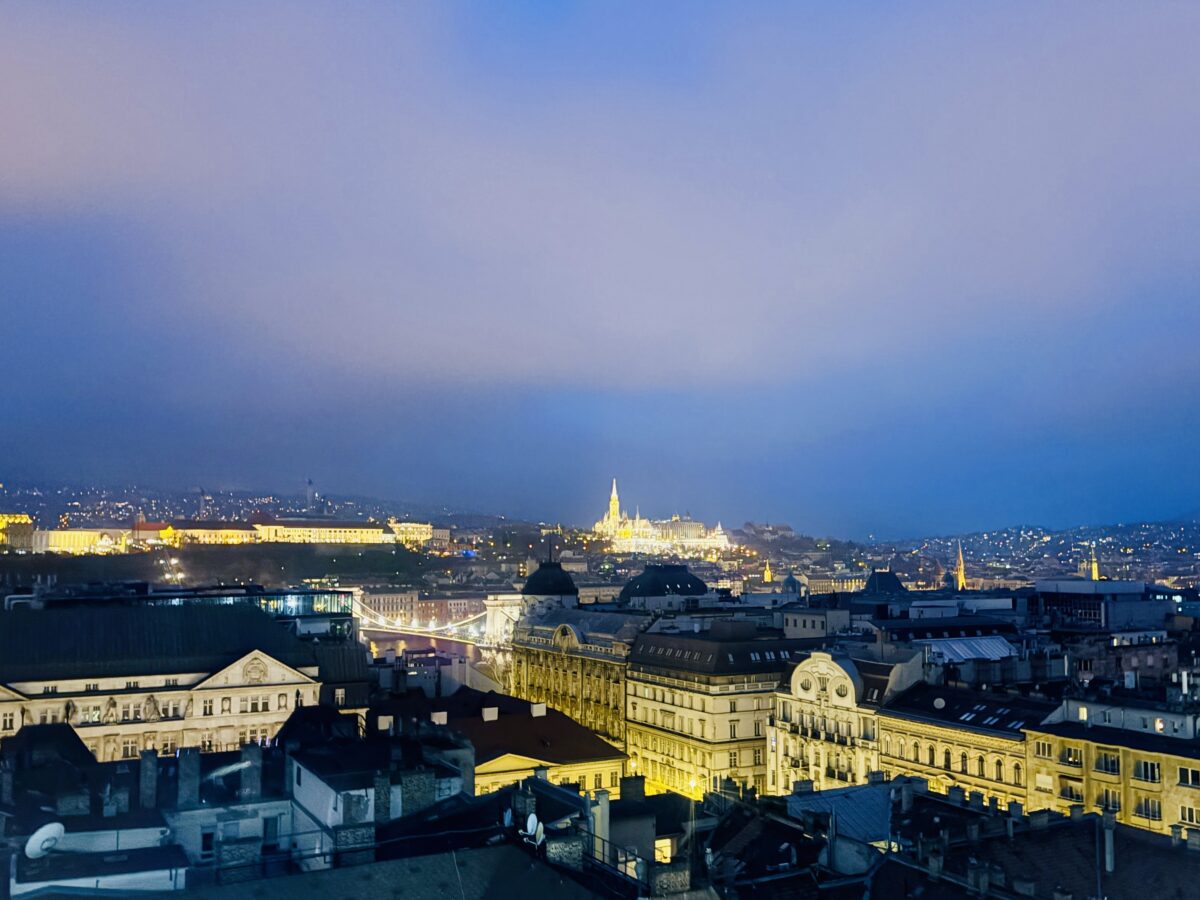
Budapest is one of those cities that looks even better from above. And no, you don’t need a private helicopter or a questionable life choice involving a rooftop selfie to get that perfect view. The Budapest Eye, a giant Ferris wheel parked right by the Danube, does the job just fine. It lifts you high enough to see the city’s grand drama unfold: the Buda Castle District clinging to its hill, the Chain Bridge stretching across the river like a steel necklace, and Pest buzzing with life on the other side.
It’s not just a pretty picture though. That skyline tells a story. And like all good stories, it involves politics, engineering, and a river that refused to pick sides.
The view that’s worth the queue
Let’s start with the obvious. The panorama from the Budapest Eye is the kind that makes you forget you paid 12 euros for a ten minute ride. To your left, Buda’s castle district looms over the city like a fairytale fortress. It’s all turrets, spires, and that one bit that looks suspiciously like Disney might have stolen it for a movie set. Below it, the Chain Bridge does its best to look elegant while carrying thousands of tourists and commuters who are probably arguing about whether Buda or Pest is better.
On the right, Pest spreads out in a mix of the Parliament building, thermal baths that have seen more skin than a beach in summer, and cafes where the coffee is strong and the pastries are stronger. The Danube, meanwhile, just flows through it all, looking smug because it knows it’s the reason this city exists in the first place.
A tale of two cities (that got tired of the commute)
Budapest wasn’t always Budapest. For centuries, it was two separate cities: Buda on the west bank and Pest on the east. They were like that couple who live together but insist on keeping separate bank accounts. Buda was the posh, hilly side with the castle and the royalty. Pest was the flat, bustling side where the common folk and the money lived.
Then, in 1873 came the bright idea to officially unite them. It wasn’t just about love. It was about economics, politics, and the fact that building bridges was suddenly in fashion. The Chain Bridge, finished in 1849, had already started the slow process of turning “let’s meet halfway” into “let’s just merge already.” By the time the cities officially became Budapest, they’d already been flirting with the idea for decades.
Why the castle district looks like it’s judging you
The Buda Castle District isn’t just there to make your Instagram feed look good. It’s been the power centre of Hungary for centuries. Kings, queens, and the occasional invading Ottoman army have all left their mark. The Royal Palace, for instance, has been destroyed and rebuilt so many times it’s basically the phoenix of architecture.
Today, it’s a mix of museums, government buildings, and tourists trying to figure out how to pronounce “Budavári Palota.” The funicular that takes you up the hill is almost as old as the unification itself. It’s steep, it’s slow, and it’s a reminder that some things in Budapest haven’t changed just because the city got a new name.
The bridge that started it all
The Chain Bridge is the granddaddy of Budapest’s bridges. When it opened in 1849, it was the first permanent connection between Buda and Pest. Before that, people relied on ferries, ice bridges in winter, and presumably a lot of creative swearing when the river flooded.
Its designer, an Englishman named William Tierney Clark, probably didn’t realise he was building a symbol of unity. Or maybe he did and just charged extra for it. Either way, the bridge survived wars, bombardments, and the kind of traffic that would make a modern engineer weep. Today, it’s still the most photogenic way to cross the Danube. Just watch out for the lovelocks. They’re cute until you realise they’re slowly turning the bridge into a giant keychain.
Pest: the side that never sleeps
While Buda plays the dignified elder, Pest is the side of town that stays up late. It’s where you’ll find the Parliament building, which looks like it’s trying to out-Gothic every other parliament in Europe. The thermal baths here aren’t just for tourists. Locals have been soaking in them since the Romans decided that Budapest’s hot springs were the ancient world’s answer to a spa day.
And then there’s the ruin bars. These are basically abandoned buildings turned into nightlife spots, because why waste a good crumbling wall when you can hang fairy lights on it? Szimpla Kert is the most famous, and it’s exactly the kind of place where you’d expect to find a poet, a DJ, and someone selling questionable artisanal liquor.
The Danube: Budapest’s liquid backbone
The river that splits Budapest is also what holds it together. The Danube has seen empires rise and fall and bridges get blown up and rebuilt. It’s wide, it’s moody, and it occasionally floods just to remind everyone who’s really in charge.
In summer, the banks turn into one big party. There are open air bars, concert stages, and enough ice cream stands to give you a sugar rush just by looking at them. In winter, the river looks like it’s plotting something under a layer of fog. Either way, it’s the reason Budapest has a skyline worth looking at in the first place.
So, is it worth the ride?
The Budapest Eye might not be the tallest or the fastest Ferris wheel in the world. But it does give you a view that’s equal parts history lesson and postcard. Up there, you can see the city that was once two, the river that divides and connects, and the bridges that made it all one.