The “Mountain Wreath” and its place in Montenegro
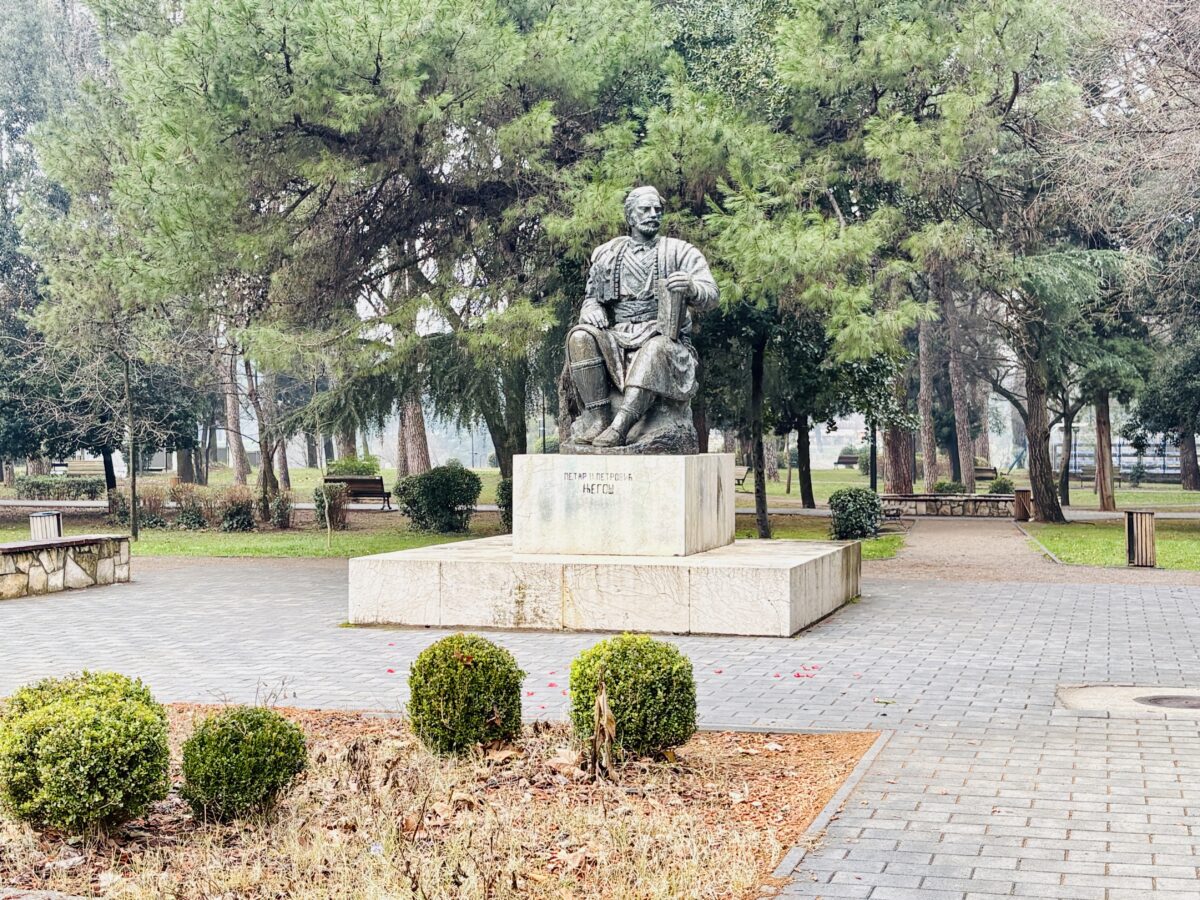
The “Mountain Wreath” is one of the most important works in Montenegrin literature. It was written in the nineteenth century by Petar II Petrović Njegoš. He was the poet prince who ruled Montenegro and also found time to write a national masterpiece. His seated statue from 1954 on Stanko Dragojević Boulevard is a familiar sight in Podgorica. It shows him in a thoughtful pose which is appropriate for a man who produced a work that still shapes the identity of a country.
There is also a huge standing statue of Petar I Petrović Njegoš in University Park on George Washington Boulevard. He is another important figure of the national history.
What kind of work it is
The “Mountain Wreath” is technically a poem. It is written in verse and follows the tradition of epic poetry. At the same time it reads like a dramatic story with characters, dialogue and a clear narrative. It is not a novel although it sometimes feels like one. It is not a play although it could easily be staged. It sits somewhere in between which is part of its charm.
The structure is simple. The language is rich. The themes are heavy. It is the kind of book that students are forced to read at school and later pretend they enjoyed every line.
The story in a nutshell
The poem is set in the eighteenth century. Montenegro is under pressure from the Ottoman Empire. The central figure is Danilo, the prince bishop. He struggles with the question of unity. The poem deals with loyalty, identity and the survival of a small community in a difficult region.
The plot revolves around a historical event known as the Christmas Uprising. It describes the decision of the Montenegrin tribes to confront those among them who had converted to Islam. The poem presents this as a dramatic moment of collective choice. It is not a cheerful story. It is full of tension and moral dilemmas. It is also full of strong imagery and memorable lines.
Why it matters so much
The Mountain Wreath is more than a literary work. It became a symbol of Montenegrin identity. It expresses the idea of resistance and the struggle for freedom. It celebrates unity and the defence of the homeland. For many Montenegrins it is a cultural foundation stone.
The poem also shaped the national narrative. It influenced how people saw their past and their role in the region. It is quoted in speeches. It is studied in schools. It is debated endlessly which is usually a sign that a book has become part of the national furniture.
A work that still sparks discussion
The “Mountain Wreath” is admired for its poetic power. It is also criticised for its portrayal of historical conflicts. Modern readers sometimes find parts of it uncomfortable. This is not surprising. Epic literature often reflects the values and fears of its time. The poem is a product of the nineteenth century and it shows.
Yet it remains central to Montenegrin culture. It is a reminder of how literature can shape a nation. It is also a reminder that national myths are rarely simple. The “Mountain Wreath” is both a masterpiece and a mirror. It shows Montenegro as it was and as it wanted to be.